
In the month of march 2020, World Health Organization declared the disease outbreak caused by a variant of coronavirus, COVID-19, as Pandemic. This set a chain of reactions across the world. Each country taking unprecedented actions to limit the spread of COVID-19 as per the recommendation of WHO. The term ‘Social distancing’ which was a typical behavior of an introversion became a necessity. ‘Social distancing’ is self explanatory, but why is it so badly required in the midst of Pandemic?
The virus can hardly be classified as a living thing. They are so small that it cannot be seen through naked eyes, often described as invisible enemy. This is as scary as the alien movies where the alien infects the human to reproduce, the only difference is the alien is invisible here. They need a host and cannot move on there own. So how do they spread? There are different mechanism by which these pathogen spread, the primary mechanism is often coming in direct contact with the infected person. By isolating the infected individual the spread of disease can be minimized and further curtailing social gathering the spread of the pathogen can be mitigated to great extent.
One of the most common thing to do when we meet someone is to greet them. And the most accepted form of greeting is ‘handshake’- a flash point for disease spread. The pandemic has forced people to be more innovative in greeting people. Each culture has its own unique way of greeting, but do you know the touch less greeting?
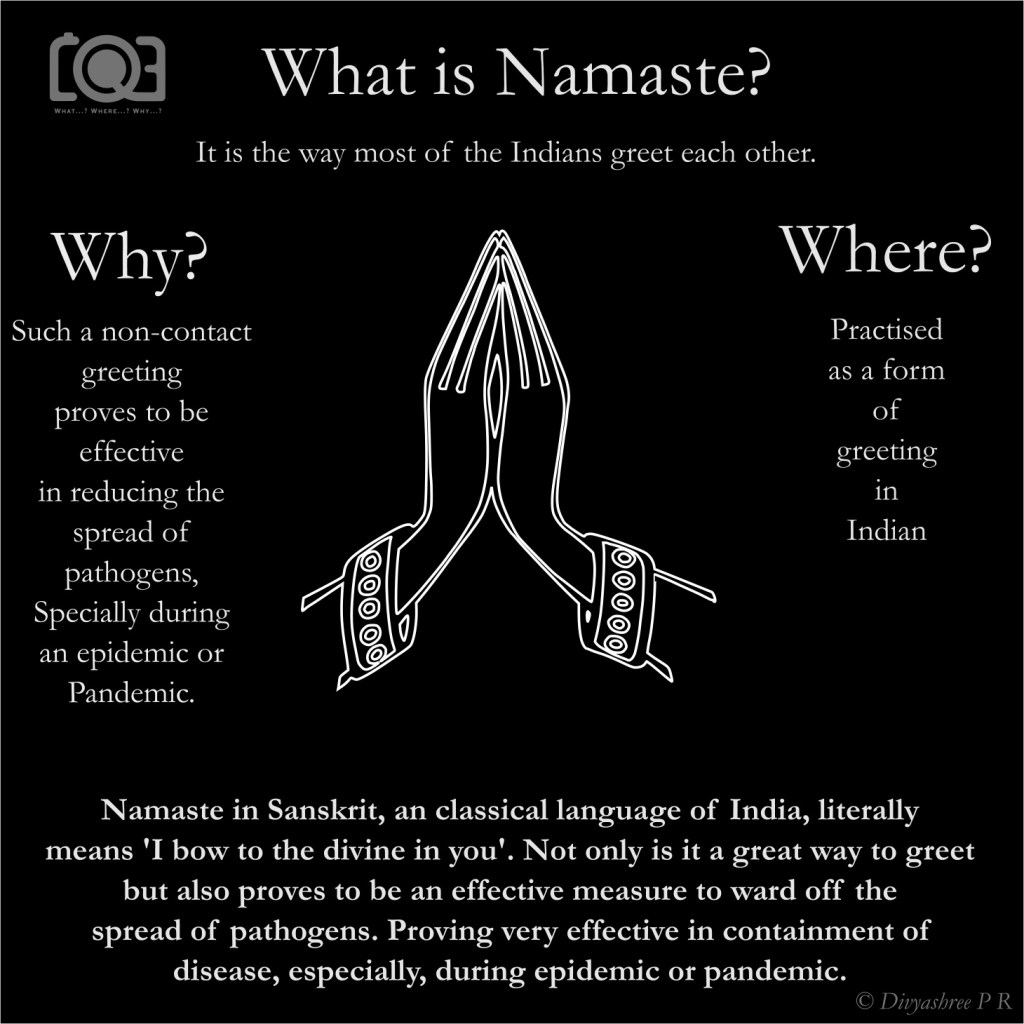
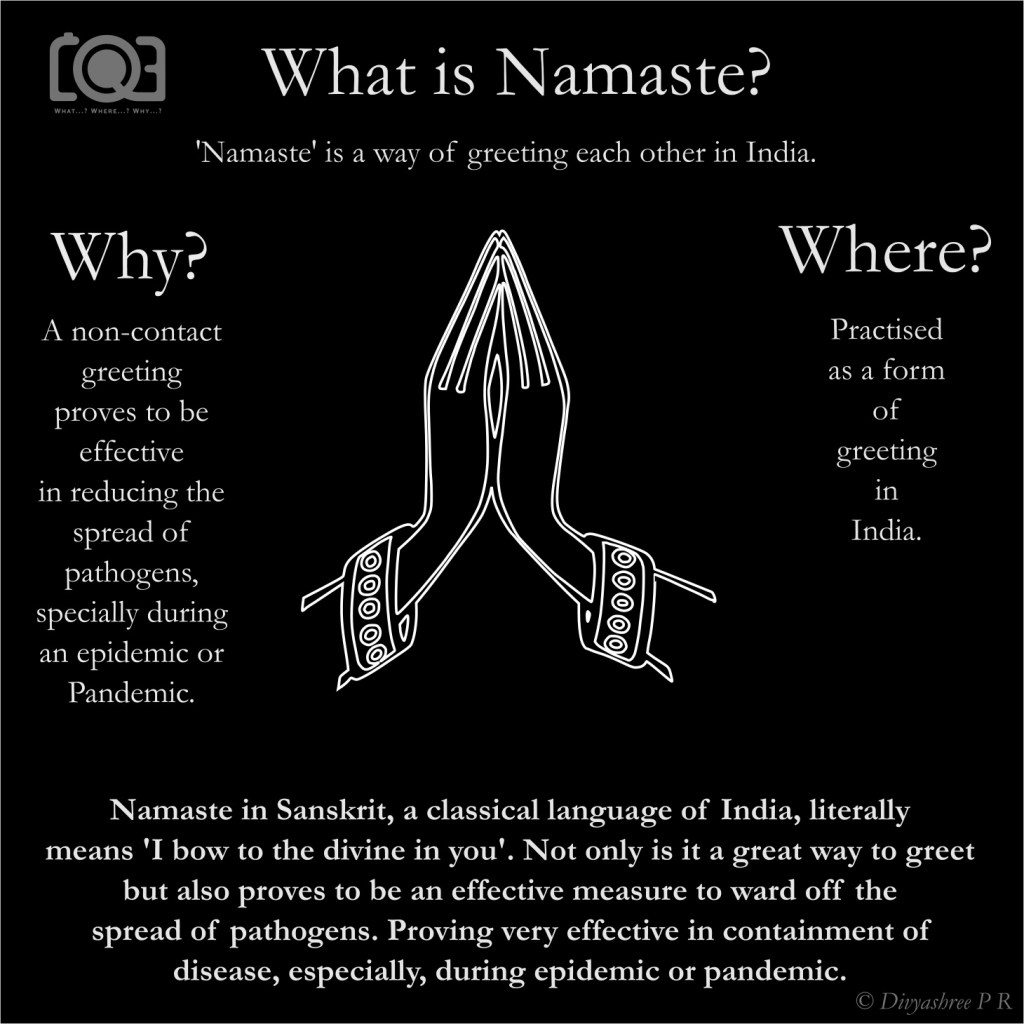
In India, people join both of their hands together, as for praying, with fingers pointing upwards and a modest bowing to greet people saying the word ‘Namaste’ or ‘Namaskara’. The word ‘Namaste’ came to English dictionary recently and the world became aware of it after the end of colonial rule in India. However, in Sanskrit, the classical language of India, the word namaste literally means ‘I bow to the divine in you’. Recently due to the spread of the COVID-19 many celebrities including the Royal family have adopted the ‘Namaste’. This might be an effective way to greet the infected person while maintain the necessary distance to limit the spread of the disease.
Are there any other touch-less greets that you have come across?
In Japan, people bow to greet each other. This greeting style is also fun. However, might not be the best when you have a headache 🙂 The greeting that brought the inner child in me was most certainly the fulfilled Tibetan greeting. That is sticking out your tongue to show deep respect to the guest. Well I did this a lot when I was young, might not be with an intention of greeting though.
Let me know if you have come across a different style of ‘touch-less’ greeting.
 Q3 Info
Leave a comment